Take an architecture tour of these 5 signature styles in New Jersey

Modern Farmhouse look in your home
How to achieve the popular Modern Farmhouse look in your home
- New Jersey is known for its diverse collection of charming historic architecture
- If you’re a lover of old houses, here are five unique architectural styles you can find in New Jersey
From vibrant Victorian manors and grand Italian villas to sleek Gregorian estates and quaint Craftsman bungalows, New Jersey’s collection of charming historic architecture is just another feature that makes it one of the nation’s most diverse states.
And what’s the point of having all these beautiful buildings if nobody looks at them? If you’re a lover of old houses and want to explore them this summer, we’ve compiled a list of five signature architectural styles and where you can find them in the Garden State.
So go for a nice summer stroll — or a drive in your air conditioned car if it’s too hot for you — and take a tour of New Jersey’s architectural gems.
Georgian
A specific style within Colonial architecture, Georgian design — named after the first four British monarchs named George — emerged in the English colonies, later becoming the United States, from 1714 to 1830. And it later experienced a resurgence during the 19th and 20th centuries. Georgian architecture is characterized by symmetrical facades, clean lines, classic materials like brick and stone, sash windows, hipped roofs and doors adorned with decorative pediments or columns.
Morristown offers several examples of preserved Georgian architecture, including the Schuyler Hamilton House on Olyphant Place, the Ford Mansion on Washington Place and the Spring Brook House on James Street. This style can also be found along many of Morristown’s residential streets.
In Princeton, the Bainbridge House in the borough’s downtown and Nassau Hall on the campus of Princeton University are also prominent examples of preserved Georgian architecture. The Western section and the Witherspoon-Jackson neighborhood in Princeton are also known for having a collection of this architectural style.
Italianate
Most popular in the United States in the mid-19th century, the Italianate style of architecture was inspired by informal Italian farmhouses and Italian Renaissance villas. Emerging as a more decorative and playful style, it’s characterized by low-pitched roofs, overhanging eaves, decorative brackets, narrow rounded windows and door frames, asymmetrical shapes and front entrances highlighted with towers, cupolas or projecting porches.
In Montclair, the Seven Sisters is a collection of homes on Chestnut Street that primarily exemplify this style of architecture. Or there is Bloomfield Villa on Llewellyn Road in Montclair, which is on the National Register of Historic Places for its preserved Italianate architecture.
The borough of Glen Ridge also has examples of Italianate architecture sprinkled throughout its streets, as well as structures like Acorn Hall in Morristown, John T. Leigh Mansion in Clinton — now the town’s municipal building — and 16 Grove Ave. in Verona.
Victorian
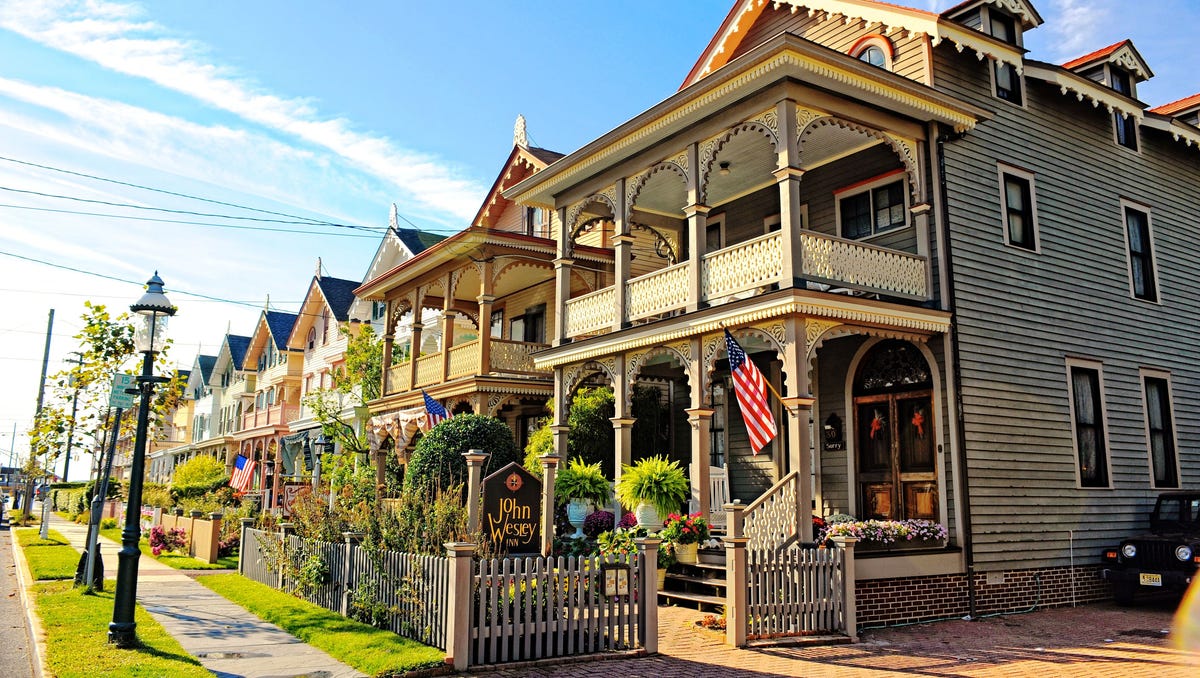
One of the most recognizable styles of architecture, Victorian-era design originated during Queen Victoria’s reign over the United Kingdom. The style was most prominent in the United States from the mid-19th century to the early 20th century and took on many variations over time, including the Queen Anne style. But it’s most characterized by ornate details — such as elaborate trim work, intricate wood carvings, gabled roofs, stained glass and a variety of window styles, among other things — as well as asymmetrical designs with porches, turrets and towers.
Mount Tabor, a 220-building historic district within Parsippany-Troy Hills that was originally established as a Methodist camp meeting ground in 1869, is widely known for housing this style of architecture. You can take a self-guided tour of this quaint North Jersey community using the Mount Tabor Historical Society’s interactive site map, or visit the area during its annual house tour.
Outside of North Jersey, Ocean Grove in Monmouth County — also once a Methodist camp meeting ground — is on the National Register of Historic Places in part for having the largest collection of authentic Victorian homes in the nation. And Cape May, located in the southernmost end of the state, is also widely renowned for its abundance of preserved Victorian architecture.
Tudor
While Tudor architecture became prominent in England during the Tudor period from 1485 to 1603, this style didn’t gain traction in the United States until the late 19th century. It emerged as a unique hybrid style, drawing inspiration from late Medieval English and early Renaissance design. It’s defining characteristic is half-timbered construction — where the timber framing is exposed on the exterior, with spaces filled with brick, stone or plaster — as well as other features like steeply pitched roofs, prominent chimneys, gables and tall, narrow windows.
The historic Cheelcroft section of Ho-Ho-Kus, a 215-home neighborhood to the west of Route 17, offers many examples of authentic Tudor architecture. The area was first developed in the early 1920s by builder and architect Harold W. Cheel, and while it incorporates an array of architecture, many of the properties feature elements of Tudor design.
The Montrose Park Historic District in South Orange is also home to many Tudor-style homes, which you can explore by following the Montrose Park Historic District Association’s self-guided walking tour. Other New Jersey towns that feature Tudor architecture include Maplewood, Ridgewood and Rumson.
Craftsman
Originating in the late 19th century, and becoming popular in the United States from the early to mid-20th century, the Craftsman style of architecture flourished as a reaction against the ornate Victorian style of the time. This design — inspired by the Arts and Crafts movement — emphasizes simplicity and functionality, and is characterized by low-pitched gable roofs, deep overhanging eaves, exposed rafters or decorated brackets, porches with square columns and natural materials like wood and stone.
Mountain Lakes, a residential community in Morris County, features an array of Craftsman-style homes. The area was developed by Herbert J. Hapgood starting in 1910, who was heavily influenced by the Arts and Crafts movement at the time.
With a mix of both older and newer versions of this style, Ridgewood has several neighborhoods that exemplify the Craftsman style of architecture. These areas include the Floral Park neighborhood, Southeast Ridgewood, Southwest Ridgewood and Northeast Ridgewood.
Maddie McGay is the real estate reporter for NorthJersey.com and The Record, covering all things worth celebrating about living in North Jersey. Find her on Instagram @maddiemcgay, on X @maddiemcgayy, and sign up for her North Jersey Living newsletter. Do you have a tip, trend or terrific house she should know about? Email her at [email protected].
link