The influence of traditional regional architectural culture on Neo-Chinese style furniture design: a case study of the lingnan region in China
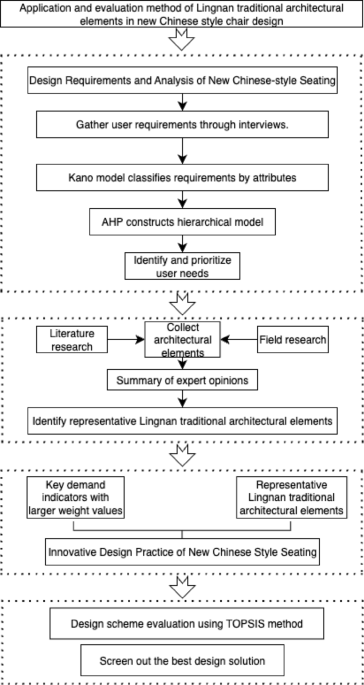
Through the analysis and calculation of user demand indicators for Neo-Chinese style seating design, the weights and priority rankings of each indicator were obtained. As shown in the results from Tables 8, 9, 10, 11, 12, users place the greatest emphasis on the integration of aesthetic form and regional cultural expression in furniture design. This is followed by concerns regarding material quality and craftsmanship, and then emotional value and functional usability.
Specifically, among all design indicators, “Concise and elegant in design (U12)” ranks first with a weight of 0.1156, indicating users’ strong preference for furniture with clean and graceful form language. “Incorporation of traditional or regional cultural elements (U15)” follows closely with a weight of 0.1147, reflecting users’ high regard for the cultural meaning and regional identity conveyed through furniture. This highlights that furniture is viewed not only as a practical object but also as a cultural carrier. In addition, “Natural and high-quality materials (U18)” and “Exquisite craftsmanship (U19)” rank third and fourth, with weights of 0.1033 and 0.0952 respectively, indicating user attention to the physical quality and workmanship of furniture. These findings underscore the importance of material authenticity and refined detail, especially considering furniture’s long-term use. Moreover, “Cultural connotation and sense of identity (U23)” ranks fifth with a weight of 0.0801, suggesting that cultural expression in furniture design should extend beyond surface-level symbols to resonate emotionally with users. When elements of Lingnan architectural culture are effectively integrated into furniture and evoke user empathy and recognition, they significantly enhance the product’s cultural depth and brand value. Additionally, indicators such as “Novel and unique design (U16),” “Harmonious proportions (U14),” and “Comfortable to use (U8)” also rank among the top eight. This shows that while users value traditional cultural expression, they also maintain high expectations for modern aesthetics and ergonomic functionality. In contrast, indicators such as “Easy to clean and maintain (U10)” and “Harmonious color coordination (U17)” receive relatively lower weights, suggesting they have a comparatively minor influence on overall user satisfaction.
In summary, this study, through the KANO-AHP analysis, not only revealed the hierarchical structure of user concerns regarding Neo-Chinese style furniture design, but also provided a clear basis for subsequent innovative design. During the design process, priority should be given to the deep integration of aesthetic form and regional cultural elements, while also taking into account materials, craftsmanship, and user experience, in order to achieve an organic unity of aesthetics, cultural value, and practicality in furniture products.
Design practice
Selection and refinement of Lingnan architectural elements
As one of the most representative regional architectural styles in China, Lingnan architecture is rich in historical heritage and distinct aesthetic characteristics. Its unique identity is reflected in structural forms, decorative details, color schemes, and spatial composition. Integrating Lingnan architectural elements into the design of Neo-Chinese style seating not only contributes to the inheritance and continuation of traditional culture but also enhances the cultural value and market appeal of the product. This approach improves the regional identity and cultural depth of furniture design. Therefore, selecting Lingnan architectural elements as cultural input for Neo-Chinese style furniture is both contextually appropriate and aligned with modern consumers’ pursuit of products that combine cultural meaning with personalized aesthetics.
To minimize subjective bias in the selection of Lingnan architectural elements and solution design, a structured decision-making process was adopted. During the selection stage of Lingnan architectural elements, a panel of seven experts was invited to participate, including two scholars specializing in Lingnan traditional architectural heritage, two senior architects, and three expert designers of Neo-Chinese style furniture products. The selection of these experts was based on their professional experience, academic achievements, and knowledge of Lingnan traditional architecture and contemporary furniture design, ensuring a balanced perspective across the fields of culture, architecture, and product design. The evaluation was conducted using a multi-stage Delphi method to ensure systematic selection and minimize subjective bias. First, through literature research and on-site field investigations in the Lingnan region, more than 30 commonly seen Lingnan architectural elements were collected, such as gray sculptures, wok-handle-shaped gables, Manchurian windows, Lingnan-style columns, and ridge-top decorative totems. Second, the experts independently evaluated each architectural element using a 7-point Likert scale (1 = very low, 7 = very high) across three key dimensions: cultural representativeness, visual communicability, and design adaptability for transformation. The scoring was conducted anonymously to reduce bias and mutual influence. Through multiple rounds of scoring and discussion, only those elements with an overall mean score above 5 across the three evaluation dimensions were retained. Ultimately, a set of highly representative Lingnan architectural cultural elements was selected to serve as the primary cultural inputs and sources of inspiration for the subsequent Neo-Chinese style seating design.
Solution design
Based on the above analysis, innovative design practices of Neo-Chinese style seating were carried out. While traditional Lingnan architectural elements were systematically extracted and transformed, the designs go beyond simple cultural reproduction by introducing contemporary innovations. These include ergonomic optimization for modern users, integration of traditional mortise-and-tenon joinery with advanced manufacturing technologies, and reinterpretation of cultural motifs through minimalist forms. Collectively, these innovations aim to create furniture that bridges tradition and modernity, offering both cultural resonance and practical value for contemporary living spaces.
Scheme 1: The top rail of the chair is inspired by the iconic “dragon boat ridge” commonly found on the roofs of traditional Cantonese architecture. The decorative pattern on the backrest draws from the “pinwheel motif” often seen in window ornaments and the “寿” (longevity) character in gray sculptures, both of which are typical in Lingnan architectural decor. The “short beam” above the arched stretcher features the “square victory pattern”, another classic window decoration in Cantonese buildings. Overall, the design conveys auspicious meanings such as health, longevity, prosperity, and endless good fortune. The pinwheel motifs on both sides of the backrest are crafted using traditional mortise-and-tenon joint techniques and openwork carving, while the center of the backrest is upholstered for comfort without compromising aesthetics. For materials, the main frame is made of high-quality black walnut, known for its durability and elegant grain. The seat and backrest cushions use premium leather combined with high-density memory foam to achieve a balance of softness and support, enhancing overall comfort. The chair legs are finished with high-quality brass sleeves, which not only improve durability and stability but also add a refined decorative touch. The color palette of brown and light green offers a fresh and lively tone beneath a calm, subdued base. When paired with the texture and luster of brass, the overall look becomes more sophisticated and contemporary. In addition to aesthetic innovation, this design integrates traditional Lingnan motifs with ergonomic principles and a lightweight structural frame, creating a seating solution that not only inherits cultural heritage but also meets modern lifestyle needs. The extraction and transformation process of architectural elements is illustrated in Fig. 5.
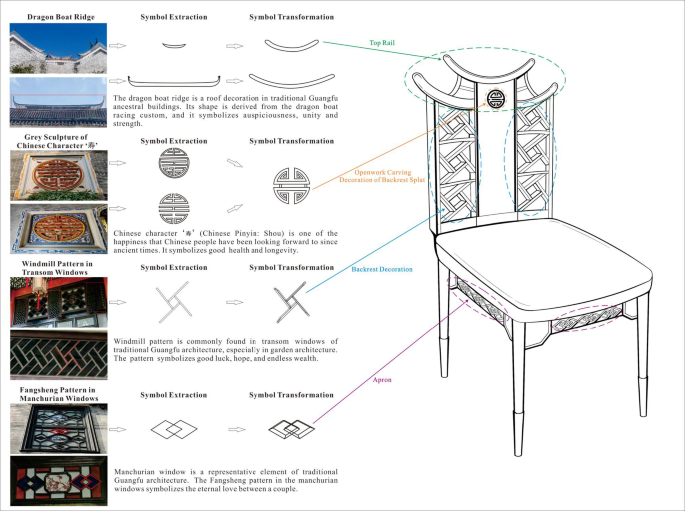
The design element extraction process of solution 1.
Scheme 2: The top headrest design of this chair draws inspiration from the elegant and smooth curves of the wavy gables commonly seen in traditional Cantonese architecture. The shape of the back panel is inspired by the “treasure vase” motif often found in traditional decorative patterns, symbolizing peace and blessings. The overall backrest frame takes reference from the “banana leaf” pattern, while the decorative crossbeam between the chair legs (known as “wangban”) is derived from the “flying eaves” element in Lingnan architectural ornamentation. By incorporating these traditional architectural forms and motifs, the chair conveys rich cultural connotations and auspicious meanings of peace, health, and a promising future. In terms of materials, the main frame is constructed from high-quality black walnut, known for its beautiful grain, strength, and durability. The seat and backrest are upholstered with premium velvet fabric and high-density memory foam, offering a balanced softness for enhanced comfort. The chair legs are finished with high-quality brass sleeves, which not only improve durability and stability but also enhance the overall aesthetic and decorative appeal. The combination of warm walnut brown and cowhide leather creates an elegant visual effect. In addition to the cultural symbolism, this design incorporates ergonomic contouring and a reinforced structural frame to enhance stability and comfort for daily use. Furthermore, by transforming traditional motifs into streamlined and concise and elegant forms, the chair achieves a balance between historical heritage and modern aesthetic trends, thereby offering originality and relevance in contemporary interior settings. The process of extracting and transforming architectural elements is illustrated in Fig. 6.
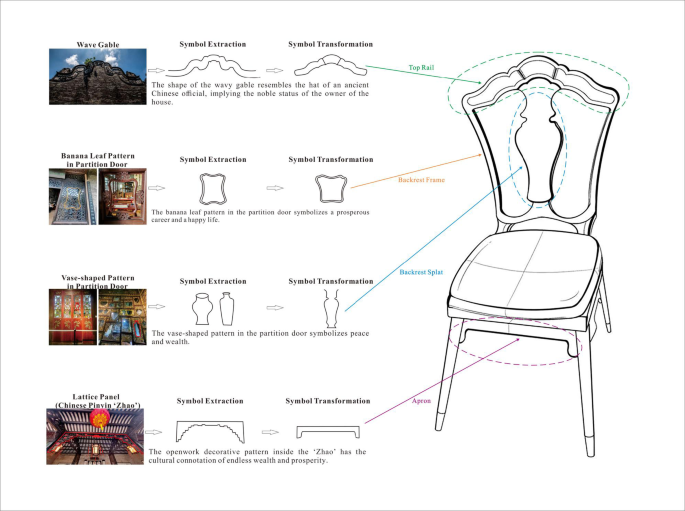
The design element extraction process of solution 2.
Scheme 3: The design inspiration for the headrest of the chair’s backrest is derived from the elegant and flowing curves of the “Wok Ear Wall”, a representative element of traditional Guangfu architecture, which culturally symbolizes happiness and a promising future. The segmented upholstered backrest design is inspired by the “Sliding Lattice Door” , another iconic architectural feature. The hollowed-out armrest decorations draw from the “Persimmon Calyx Pattern” commonly found in the windows and doors of traditional Guangfu buildings, symbolizing auspicious meanings such as prosperity and success. The decorative panel connecting the chair legs is inspired by the “Hanging Drop” , and the leg design references the “Spiral Wooden Railings”, enhancing the fusion of Chinese and Western design elements. This also reflects the inclusive and eclectic spirit of Guangfu architecture. The chair is constructed using high-quality North American black walnut, known for its beautiful grain and durability. It is paired with a comfortable seat cushion and back cushion, made from premium leather and high-density memory foam to enhance seating comfort. The brown tone of the wood and the brownish yellow tone of the upholstery belong to the same color family, conveying a sense of natural warmth, calmness, and harmony. Beyond its visual appeal, this design introduces innovative features such as segmented backrest construction and ergonomic support zones, addressing contemporary comfort requirements while maintaining cultural authenticity. The reinterpretation of Lingnan architectural elements through a fusion of Chinese and Western stylistic cues provides a unique and original design language that distinguishes this chair within modern furniture markets. The extraction and transformation process of architectural elements is illustrated in Fig. 7.
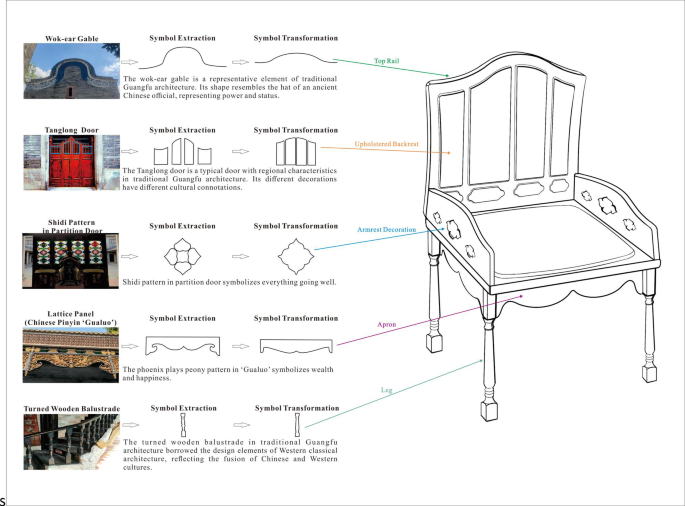
The design element extraction process of solution 3.
Scheme 4: The backrest shape and decorative elements of this chair are inspired by the Floor-Mounted Canopy, a traditional architectural feature in Guangfu buildings. The “Ice Crack Pattern” on the edge of the backrest symbolizes cultural ideals such as perfection and open connectivity (“perfection in all aspects, universal access”). The central motif on the backrest features the “Persimmon Calyx Pattern,” representing prosperity and a harmonious life. The Persimmon Calyx Pattern is positioned centrally on the upholstered backrest, while the Ice Crack Pattern is applied along the edges using traditional mortise-joinery and hollow-carving techniques. These elements complement each other, combining aesthetics and comfort without interference. The lower support element, known as the Short Brace, references the “Falling Flower and Flowing Water” motif commonly found in window decoration. The structural components connecting the seat and legs are derived from traditional Guangfu elements such as the Hanging Drop and the Bracket Arm, enhancing both the structural stability and decorative appeal of the chair. The main frame is constructed from high-quality black walnut, known for its attractive grain and durability. The seat and backrest are upholstered with premium leather and high-density memory foam, providing a well-balanced level of softness and support for enhanced comfort. The natural brown grain of the wood creates a visually pleasing organic aesthetic, while the light brown leather adds warmth and coziness. The harmonious color combination helps create a welcoming and comfortable home atmosphere. At the same time, this design integrates traditional mortise-and-tenon craftsmanship with CNC fabrication technology, preserving the essence of traditional techniques while meeting the modern manufacturing requirements for standardization and mass production. Its innovative interpretation of the floor-mounted canopy and ice crack pattern endows the chair with profound cultural connotations, while also catering to contemporary demands for exquisite craftsmanship and a novel, distinctive modern aesthetic. The fusion of traditional artistry and forward-looking functionality underscores the design’s originality and adaptability in today’s furniture landscape. The process of extracting and transforming architectural elements is illustrated in Fig. 8.
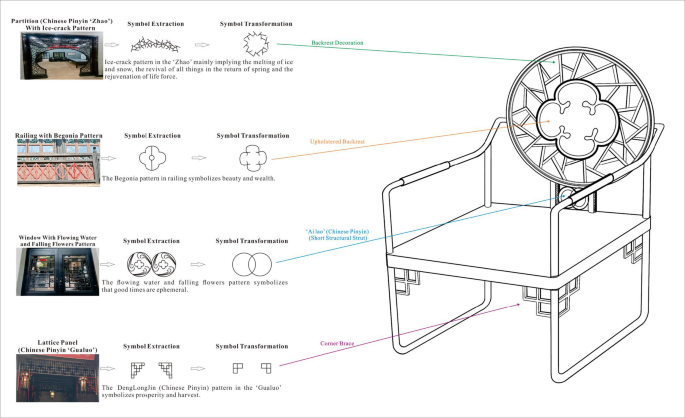
The design element extraction process of solution 4.
The final design renderings of the four Lingnan-style Neo-Chinese chairs are shown in Figs. 9, 10, 11, 12.
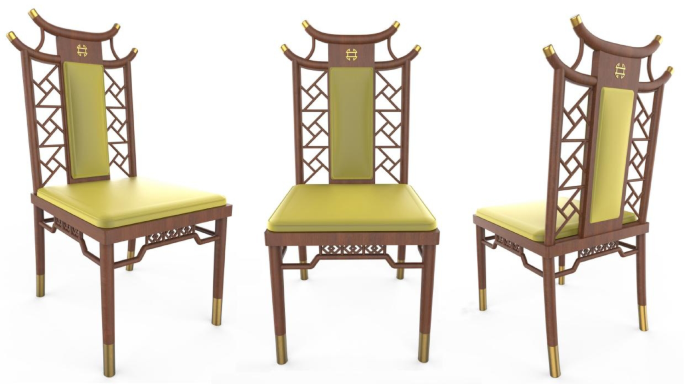
Final model diagram of design scheme 1.
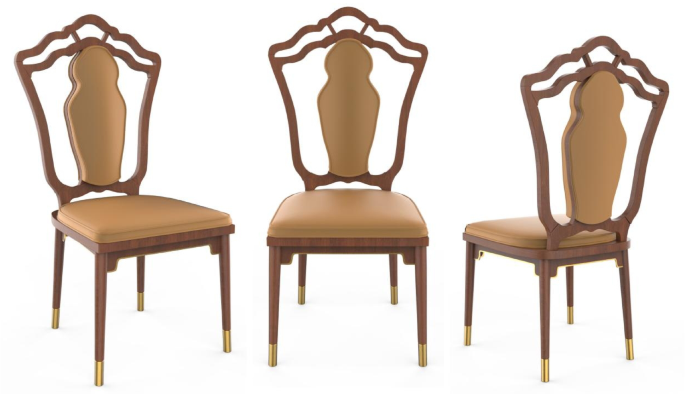
Final model diagram of design scheme 2.
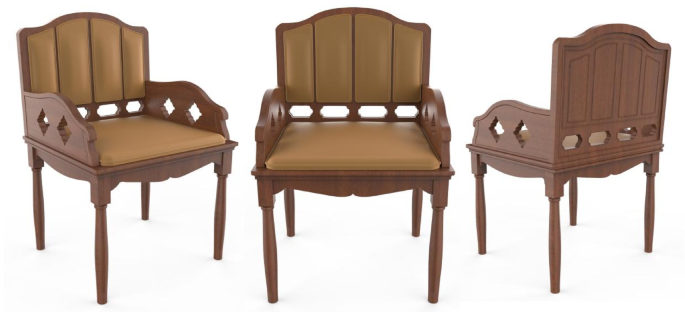
Final model diagram of design scheme 3.
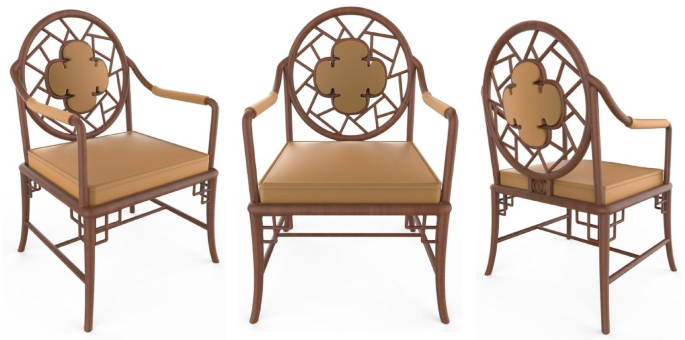
Final model diagram of design scheme 4.
Program evaluation and screening
To verify the feasibility of the proposed designs and identify the optimal solution, this study adopts the Technique for Order Preference by Similarity to Ideal Solution (TOPSIS), also known as the “ideal solution proximity method” or “distance-to-ideal solution method.” TOPSIS is a widely used multi-criteria decision-making (MCDM) tool developed by C.L. Hwang and K. Yoon in 198153. The core idea of TOPSIS is to rank alternatives based on their geometric distances from a positive ideal solution (best case) and a negative ideal solution (worst case). The closer an alternative is to the positive ideal and the farther it is from the negative ideal, the better its overall performance. This method is well-suited for evaluating multiple alternatives under multiple criteria, providing decision-makers with a rational basis for selecting the optimal design.
To ensure the objectivity and validity of the evaluation results, this study invited the expert panel involved in the indicator development to participate in the scheme evaluation. The experts assessed each design scheme based on the following evaluation criteria: ergonomics and comfort design, visual aesthetics, high-quality materials and craftsmanship, skilfully integration of representative Lingnan architectural elements, and innovation and personalized expression54,55,56,57,58. A standardized evaluation form (as shown in “Supplementary material File S2”) was employed to score each design solution, using a 7-point Likert scale. The scoring process was conducted anonymously and independently to ensure the reliability of the data. The specific evaluation process of the design alternatives using the TOPSIS method is detailed as follows:
-
(1)
Constructing the original decision matrix.
The original decision matrix (Table 19) was constructed based on the arithmetic mean of the scores given by the seven experts for the four design solutions across each evaluation criterion. The formula for calculating the initial evaluation matrix is as follows:
$$X = \left( {X_{ij} } \right)_{mn}$$
(8)
In the formula, m represents the number of design alternatives, and n denotes the number of evaluation criteria.
A visual representation of the evaluation results for the four design solutions is provided in Fig. 13.
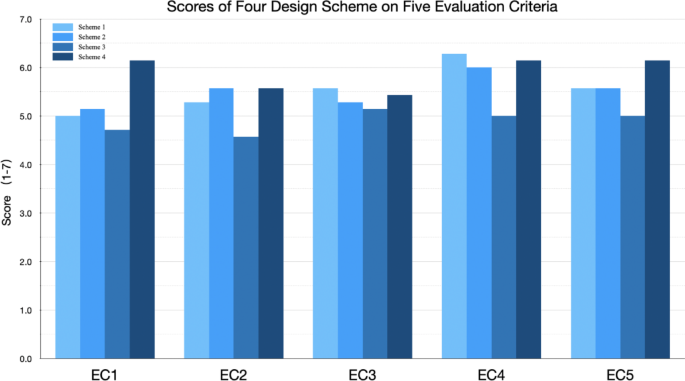
Design scheme evaluation results.
-
(2)
Calculate the weighted normalized decision matrix.
The data collected from the four design proposals were subjected to weighted standardization. The resulting weighted standardized evaluation matrix is shown in Table 20. The initial evaluation matrix (Table 6) was standardized using the vector normalization method (see Formula 9), resulting in the standardized matrix \(Y = \left( {Y_{ij} } \right)_{mn}\). By combining the weights \(\omega\) assigned to each evaluation criterion, the weighted standardized matrix \(Z = \left( {Z_{ij} } \right)_{mn}\) was obtained, as shown in Formula (10):
$$Y_{ij} = \frac{{X_{ij} }}{{\sqrt {\sum\limits_{i = 1}^{m} {X_{ij}^{2} } } }}\left( {i = 1,2,…,m;j = 1,2,…,n} \right)$$
(9)
$$Z_{ij} = \omega_{i} Y_{ij} \left( {i = 1,2,…,m;j = 1,2,…,n} \right)$$
(10)
-
(3)
Determine the positive and negative ideal solutions for the evaluation object.
The computation of the positive ideal solution is presented in Eq. (11), while the negative ideal solution is calculated according to Eq. (12).
$$Z^{ + } = \left( {Z_{1}^{ + } ,Z_{2}^{ + } ,…,Z_{n}^{ + } } \right)$$
(11)
$$Z^{ – } = \left( {Z_{1}^{ – } ,Z_{2}^{ – } ,…,Z_{n}^{ – } } \right)$$
(12)
According to Eqs. (11) to (12), the positive ideal solution for the evaluated objects is denoted as \(Z^{ + } = \left( {{0}{\text{.419}},{0}{\text{.441}},{0}{\text{.404}},{0}{\text{.406,0}}{.420}} \right)\), while the negative ideal solution is \(Z^{ – } = \left( {{0}{\text{.322}},{0}{\text{.321}},{0}{\text{.355}},{0}{\text{.323,0}}{.326}} \right)\).
-
(4)
Calculate the distance between each solution and the positive and negative ideal solutions.
.
Based on Eqs. (13) to (14), the distances from each design alternative to the positive and negative ideal solutions, denoted as \(D^{ + } ,D^{ – }\) respectively, were calculated. The results are as follows: \(D^{ + } = \left( {{0}{\text{.056}},{0}{\text{.050}},{0}{\text{.093}},{0}{\text{.031}}} \right)\), \(D^{ – } = \left( {{0}{\text{.047}},{0}{\text{.049}},{0}{\text{.000}},{0}{\text{.071}}} \right)\).
$$D_{i}^{ + } = \sqrt {\sum\limits_{j = 1}^{n} {\left( {Z^{ + } – Z_{ij} } \right)^{2} } }$$
(13)
$$D_{i}^{ – } = \sqrt {\sum\limits_{j = 1}^{n} {\left( {Z^{ – } – Z_{ij} } \right)^{2} } }$$
(14)
-
(5)
Calculate relative closeness.
The relative closeness of each design alternative to the ideal solution, denoted as C, was determined, with the results as follows: C = (0.459, 0.495, 0.000, 0.698). The calculation formula is given in Eq. (15):
$$C_{i} = \frac{{D_{i}^{ + } }}{{D_{i}^{ + } + D_{i}^{ – } }}\left( {i = 1,2,…,m} \right)$$
(15)
The closeness coefficient serves as a key indicator for evaluating how closely a design scheme approaches the ideal solution. When the closeness coefficient approaches 0, it indicates that the scheme is nearer to the negative ideal solution, meaning its performance across multiple evaluation criteria is unsatisfactory and may exhibit significant shortcomings or deficiencies. Conversely, when the closeness coefficient approaches 1, it implies that the scheme performs excellently across various criteria, effectively meeting or even exceeding expected requirements and expectations. Based on the values of the closeness coefficient, the schemes can be ranked accordingly. As shown in Table 21, Scheme 4 achieves the highest closeness coefficient, indicating it is the optimal scheme among all the evaluated alternatives.
Based on the evaluation results, the experts who participated in this assessment highly recognized all five evaluation dimensions. This confirms the strong applicability and effectiveness of the proposed design framework in meeting the diverse needs of users for Neo-Chinese style seating. Therefore, the innovative design approach developed in this study—based on the KANO model and Analytic Hierarchy Process (AHP)—is considered both practical and feasible. This research not only focuses on improving user experience but also skillfully integrates elements from traditional Lingnan architecture into the Neo-Chinese style seating design. This integration enhances the product’s cultural value and design innovation, addressing the longstanding disconnection between traditional architectural and furniture styles. Through this study, we aim to create living spaces that are more comfortable, aesthetically pleasing, and rich in cultural meaning. This responds to the growing demand for higher quality in modern living.
link